HOW IT WORKS / THE BUG-TO-FIX LOOP
From first install.
To your next fix.The context goes with you.
One useful issue.
For you and your coding agent.
Add capture. See what broke. Give your agent the evidence. Review the proposed fix and watch the next release.
No credit card. Guided setup keeps your place.
you Why did checkout fail?
↳ get_repro_context
POST /api/checkout → 500
Replay · request · console · stack
↳ get_bug_events
One report. The context to start.
you Find the bug that matters.
↳ list_recommended_critical
Checkout failed
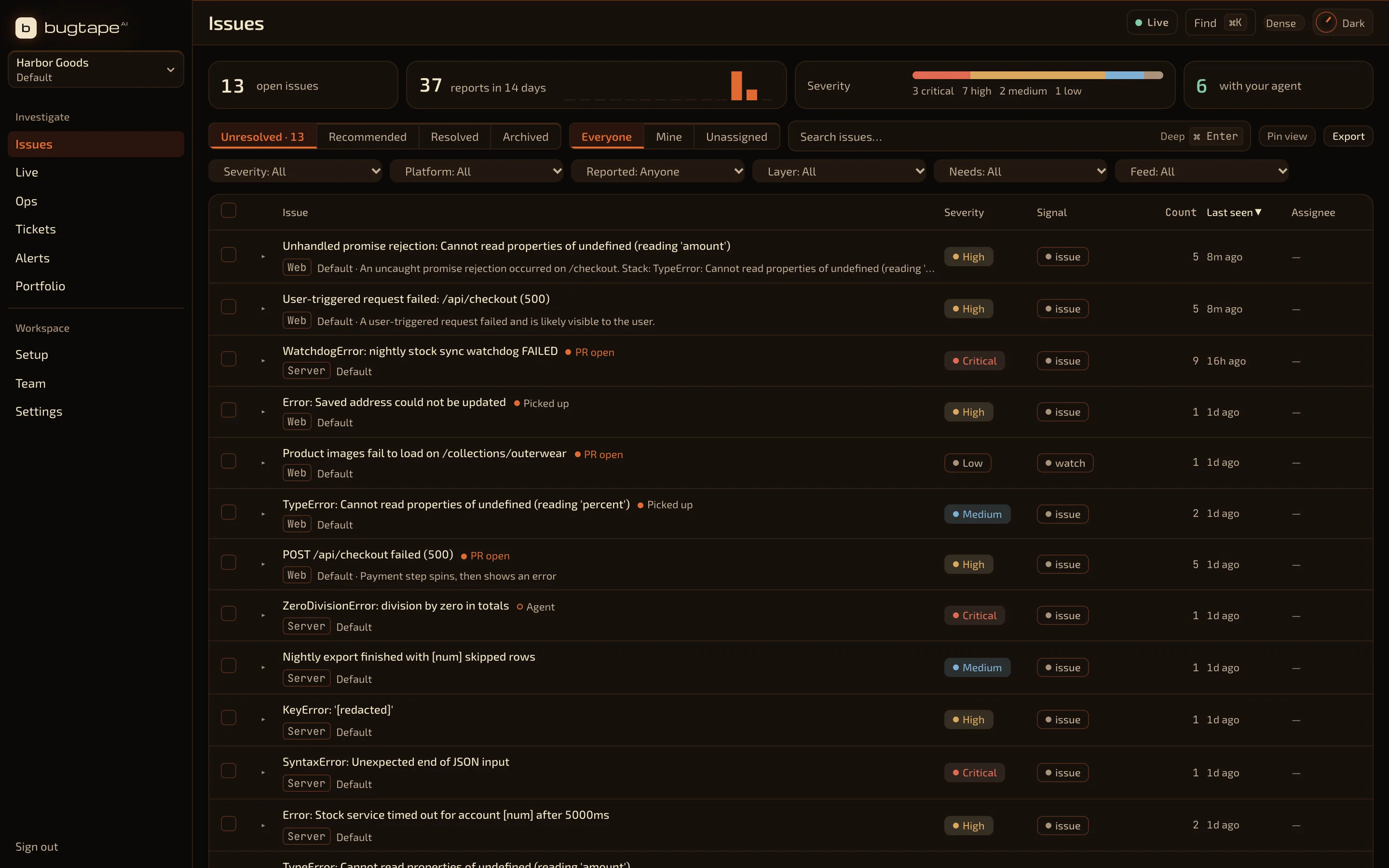
Repeated reports → one issue
↳ get_repro_context
Less noise. A clear place to start.
you Share the bug evidence.
↳ get_repro_context
Context ready to investigate
Replay · request · console · stack
↳ ack_bug
Agent proposes. You review.
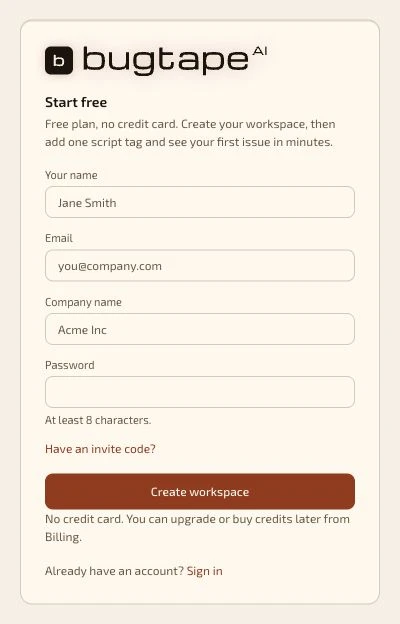
you Let’s get started.
→ Create your workspace
Name · email · company · password
No credit card. No sales call.
→ Continue to guided setup
Your next step is already there.
you Let’s set up capture.
→ Choose privacy. Add SDK.
Send your first app report.
Check delivery in Setup.
→ Connect your agent
Real checks. Clear progress.
Product tour: real UI captures with synthetic data. Illustrative agent workflow.
LESS BACK AND FORTH
A bug report.
With a place to start.
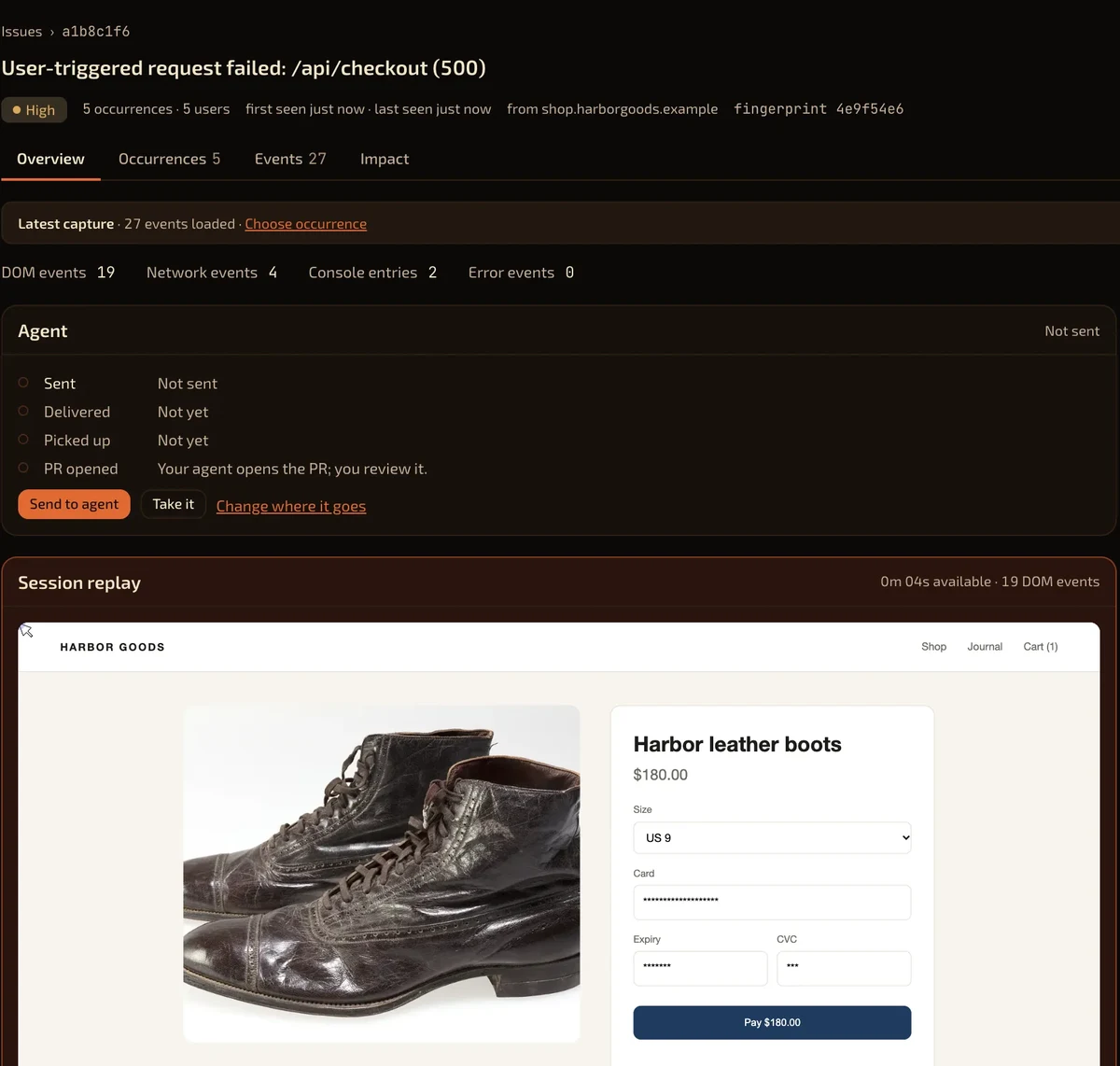
A message that says “checkout is broken” leaves you guessing. BugTape brings the browser replay, failed request, console and stack into one issue. You and your agent start with the same evidence.
01 / MAKE IT YOURS
Choose your privacy.
Then add capture.
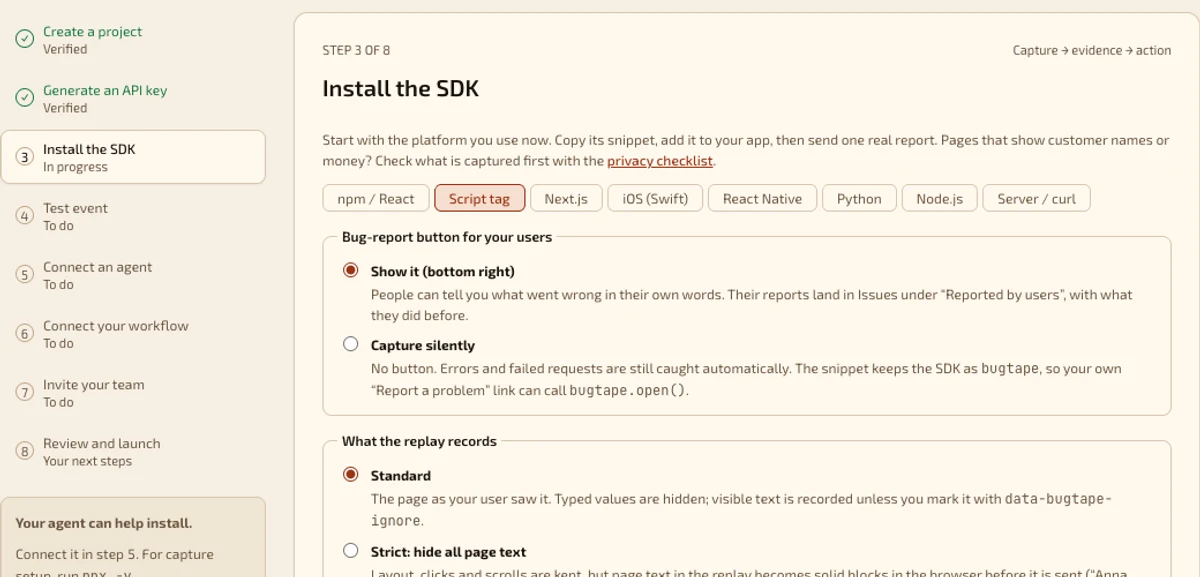
Create a project and capture key. Setup walks you through privacy, your SDK and a first report from your app. Its progress menu keeps your place.
Choose what your app records.
Show the report button or capture silently. Use standard replay, stricter text masking or error-only capture.
Add the SDK for your runtime.
Paste the generated snippet into your app. Keep server keys in your server environment.
Send one report from your app.
Open its evidence in BugTape. A console sample does not prove your app is installed.
<script type="module">
  import { init } from 'https://app.bugtape.ai/bugtape.mjs';
  init({ apiKey: 'bt_live_your_key_here' });
</script>Illustrative install examples use SDK defaults. Review privacy and use your own capture key in Setup.
All runtimes and install guides ↗02 / SEE WHAT HAPPENED
The moment it broke.
The evidence beside it.
The browser SDK keeps a rolling buffer in memory. When it reports an uncaught error, an unhandled rejection or a failed request after a click, the issue includes the captured context.
Replay the page and clicks.
The replay is rebuilt from recorded DOM events. It is not a screen video.
Read the request, console and stack.
Inspect the failure beside the activity that led to it.
Check your privacy choices.
Typed input values are hidden by default. Review real app screens before release.
Servers send error context without browser replay. Check capture support.
03 / HEAR FROM YOUR USERS
“This looks wrong.”
Now you can see why.
A wrong price or a confusing screen might not throw an error. The optional bug-report button lets someone explain the problem in their own words, with the captured context attached.
Show the button.
People can add a title, description and severity. The Reported by users filter gives these reports their own view in Issues.
Capture silently.
Automatic error capture still works. Your own “Report a problem” link can open the form with
open().
Screenshots and voice notes in the form are not available yet.
Set up the report button ↗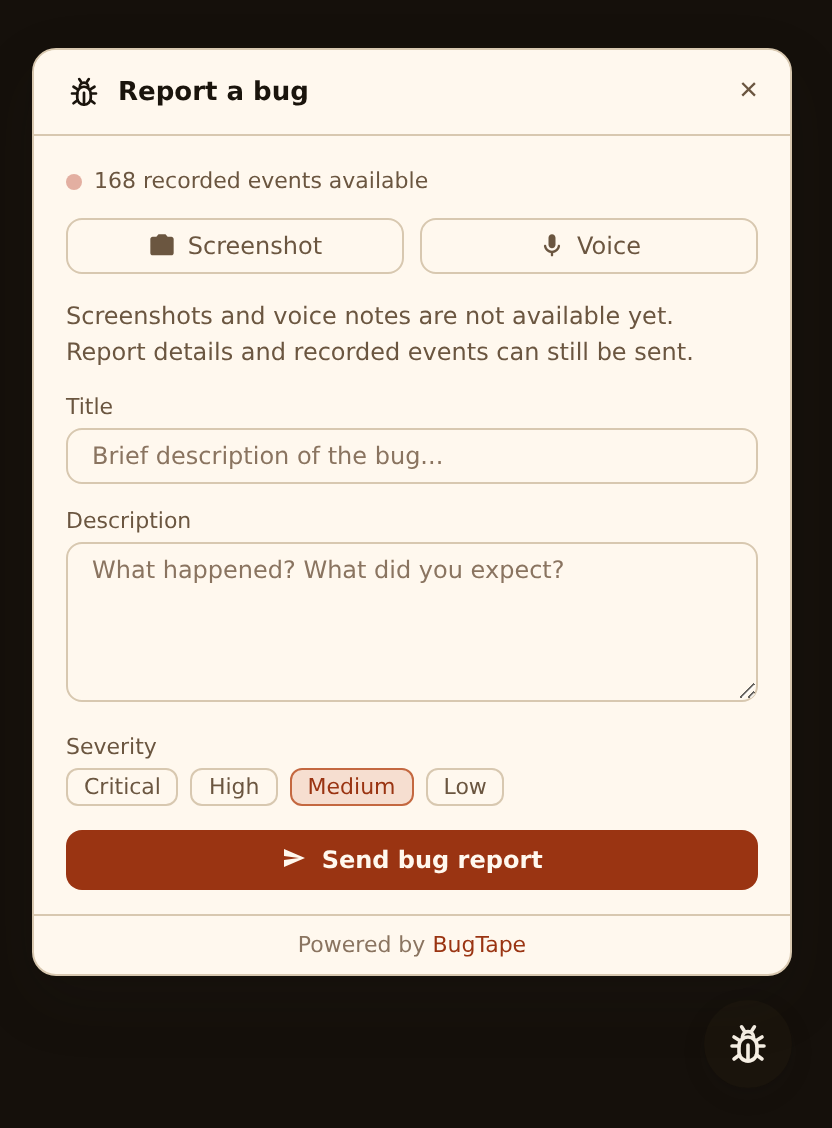
04 / FIND THE FAILURE
Repeated reports.
One clear issue.
Reports of the same failure stay together. Read the count, releases and platforms in one place. When your app sends user IDs, you can see who was affected.
Keep your inbox useful.
Open an occurrence when you need its exact context. Repeats do not become a new pile of issues.
Bring the alert to your workflow.
Connect GitHub, chat, email or a webhook. Setup checks actual delivery where the connection supports it.
05 / GIVE YOUR AGENT A START
The agent gets context.
You keep the decision.
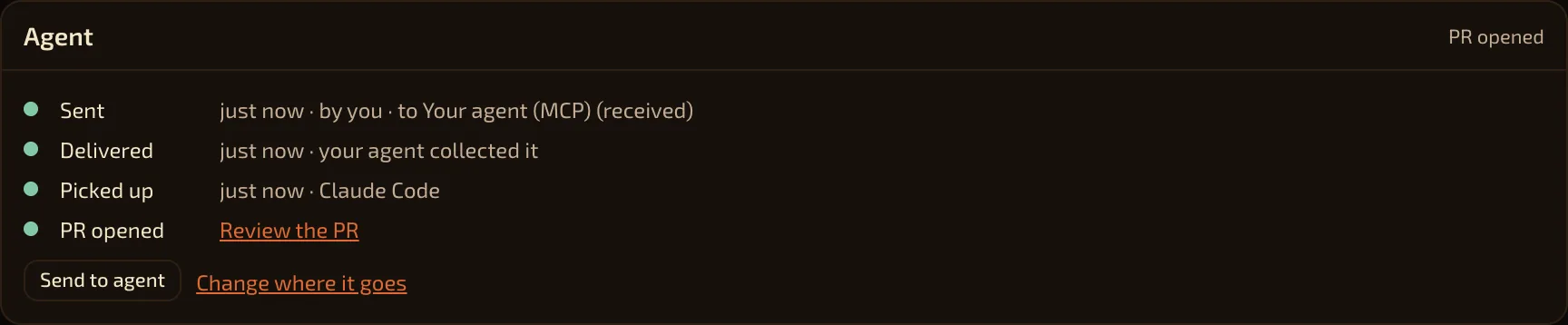
Connect Claude Code, Cursor or Codex over MCP and approve scoped access. Ask your agent to read the issue, inspect its evidence and propose a fix.
Read the same evidence.
Your agent can get the replay context, request, console and stack without a manual copy-and-paste.
Review the proposed changes.
Your agent does the code work. You review the pull request and decide what ships. A linked PR does not prove that a bug is fixed.
Watch the next release.
Keep track of new reports and recurrence after you ship.
EXAMPLE / MCP WORKFLOW
list_recommended_critical
  ↓ choose an issue
get_repro_context
  ↓ read captured evidence
ack_bug
  ↓ report progress / link your PR
Illustrative workflow. Your agent does the code work.
Tools, access and credit costs ↗LESS TIME EXPLAINING BUGS.
More time
making things.
Free to start. Built for you and your agents.